Showing posts with label scuba diving. Show all posts

Trip to Bonaire: Sunsets and Bioluminescence

Here is a thing about sunsets - there is one every day, people generally agree that they are gorgeous, and looking at them is a good way to spend your time. But we rarely see them. So during my trip to Bonaire, I wanted to make sure that I had a chance to see some sunsets - and it worked - but not 100% - and for a good reason! I missed a few sunsets because I did a few dusk-to-night dives. There is no good view of the setting sun underwater: everything gets darker and less colorful, and that's it! But that is the time when new animals emerge. After the sun is gone, you can see bioluminescence in the sea, and that is one of the most amazing things to look at, in my opinion. Bonaire has a prominent bioluminescence (when you see light by moving the water - clapping or swimming) but it is also famous for its predictable twice-a-month show of ostracods - tiny crustaceans that emit light to communicate with their potential partners (think underwater fireflies). I tried to take my sketching tools with me to these dives, but quickly discarded the idea of drawing. For one, we dove without lights, so it was really dark (don't worry - we had lights with us, but turned them off on purpose). And keeping track of your air supply, position, and buoyancy, where your diving buddy is - all that was a big enough load without light to keep me completely occupied. But also the view is incredibly unusual, and for me it was a much better experience to look at this fantastic show of light than think where my tools are and how to draw something... quite undrawable :) I found this video to show you something that might explain my thing about ostracods: 

https://www.youtube.com/watch?v=e6R4lWIZSw4

All Posts re: Bonaire 2025:

Trip to Bonaire: Sketching and Scuba Diving - Oil Pastels and Salt Water Mix Nicely

I wrote about my experiment with bringing oil pastels of different brands with me to my underwater sketching adventures on Bonaire. And below are several sketches which will show you how I: 

  • layered different colors (a lot of snugging, hard to judge results)
  • used a side of the pastel crayon to cover a large part of the page quicker (enjoyed A LOT)
  • how different pressure to different parts of the crayon created interesting texture variation (enjoyed A LOT)
  • how I used a tip or sharp edge of the crayon to add details or even write in some instances (this is ok - but I found a better way - will collect those sketches into a separate post).

Bear in mind that all the colors look very different when you are looking at them under 60-70 feet of water, so most of my color choices had to be "blind". I tried to limit the number of colors that I took with me, and remember the overall shape of the crayon, and remember how the hue would shift (from the theory that red color disappears first and so on), and from previous experience.


All Posts re: Bonaire 2025:

Sketching Under Water: Maldives 2024

All of the following sketches were done at a depth between 100 and 60 feet underwater in the Indian Ocean during my scuba diving trip to Maldives, in December 2024. After each dive, I would tear pages with sketches from my notebook, wash them in fresh water several times, let them dry, and then take these photos. A few scans below will give you a view with a little more details so that you can read my notes and see how I incorporate my underwater sketches in my sketchbook with additional notes. A separate post about materials contains information about my set-up.

Why do I draw while scuba diving? I think the simplest answer is that I just like to draw and I do it everywhere. But a little more complex version is this: the world underwater is very different from the world above the water, is very densely packed with information of all sorts and it is impossible to see and process all that is happening to you there. Drawing allows me to focus on things and pay attention for a little longer than is natural in a situation of such overwhelm. And it allows me to make notes and remember at least some of the questions that come up and all of this helps to remember and come back to these thoughts and images later. Nature journaling underwater goes on a whole new level!

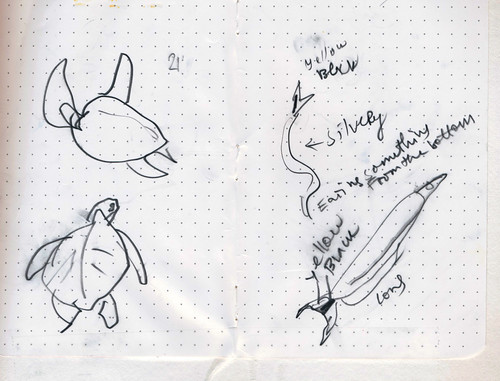
Normally I make both sketches of the surrounding landscape, and aquatic life and also some a little more detailed ones with notes of a naturalistic nature: mark what depth I was at, possible position or situation with current, etc., and add information about patterns/textures/colors/behaviors that I observe. However, on this trip I did not have a chance to stay in one place and observe things - I was with a group of people who were moving all the time, and keeping with them was one of the priorities for me. So most of my sketches are super quick gestures trying to capture the movement and feeling of the place - with very few notes. I saw lots of different sharks (some disturbingly close), witnessed close-up some shark feeding and manta ray feeding, saw manta ray on a cleaning station, sting rays and eagle rays, several octopuses, eels, lots of fish in schools (swimming through one is a special treat - I am hoping there will be a video at some point and I will share it!). Also first ever meeting Mantis Shrimp! I wish I could draw all of this and for a longer time! 


Click on the images to see them larder and read the text.


Underwater Sketching Kit

Between my previous experiences of sketching while scuba-diving and some new ideas, I created a whole set of tools that I wanted to try on this trip. They included several papers to try, several pencils to try, and a new way to add color: oil pastel! While getting ready for this adventure I went to a refresher class for scuba diving (our last trip was before the pandemic) and that is where I tested my oil pastels set-up and was super excited to bring them with me! I knew that there would be at least 15 dives so I planned to try one tool at a dive first and then pick what worked the best and continue with that set-up till the end of vacation.
Here is what the plan for the tools looked like:
Three Papers: 
1. Right in the rain all weather notebook (Plain. This is what I've been using before in all my scuba diving sketching but I am not sure it is still available so the link goes to the closest thing I found).
2. Terra Slate Waterproof paper, 5 mm - I  got a pack of loose sheets and folded them in half for my support board. This paper was recommended to me by a Rory O'Keefe | SURVEY DOWN - an amazing underwater cave cartographer. 
3. Wire-Bound Stone Paper Notebook which I cut to match my support board (which is based on the size of my scuba diving pocket). 

Oil Pastels were a collection that I created from several sets - but Faber Castell box was plastic and convenient for both transporting and keeping them in place underwater.

Pencils:
Color pencils were two no-name multicolor ones (presents from friends actually!), double-pencil is Mitsubishi Vermilion and Prussian Blue and others are short prismacolor pencils. 
Graphite Pencils were chosen for all-plastic body which means they would not rust. And here is some info about them:
1. Pilot Croquis 6B (Pilot AP-CR4-6B Croquis 6B Sketch Pen - this is a closest link I found through it leads to a very pricy version - I got mine for $6 at some point) - a pleasure of soft graphite cannot be underestimated but at depth not too many pencils keep it - this one does! 
2. Morning Glory Sketch Mechanical Pencil provided a lovely option of making thin and thin lines by having a rectangular lead 1.8 mm flat,
3. Aqua Pencil from Reef Check - picked up at the local dive shop in a pre-pandemic life. 
4. Stabilo all Aquarellable Pencil - which writes on all sorts of surfaces 
5. Carpenter pencil allows for a wide variety of marks and I used wooded ones before - this was an experiment with an all-plastic housing - Swanson Tool Co CP216 AlwaysSharp Refillable Mechanical Carpenter Pencil. The pencil is too long for my comfort and I did not get to actually test it under water. 

However, things didn't go as planned. While preparing for scuba-diving in Maldives I looked up all sorts of information about aquatic life I might encounter, water temperature, and famous diving sites. But I did not register the fact that the Maldives are a place known for the abundance of currents, sometimes treacherous. We did not encounter anything worth mentioning ourselves but got a lot of warning during dive briefings. And there were many sites with current strong enough to take my mind off any drawing - we used hooks to stay in place or move in the direction where our guide would be going. And he would always be moving - which was also not conducive for drawing. Sticking with the guide was important as the boat was tracking groups of divers, and surfacing with the guide was key to ensuring we were picked up by our vessel. As a result, I did not go through all my sketching tools and did not get to try oil pastels. So they will have to wait for my next scuba-diving adventure :) 
Here what I actually used:
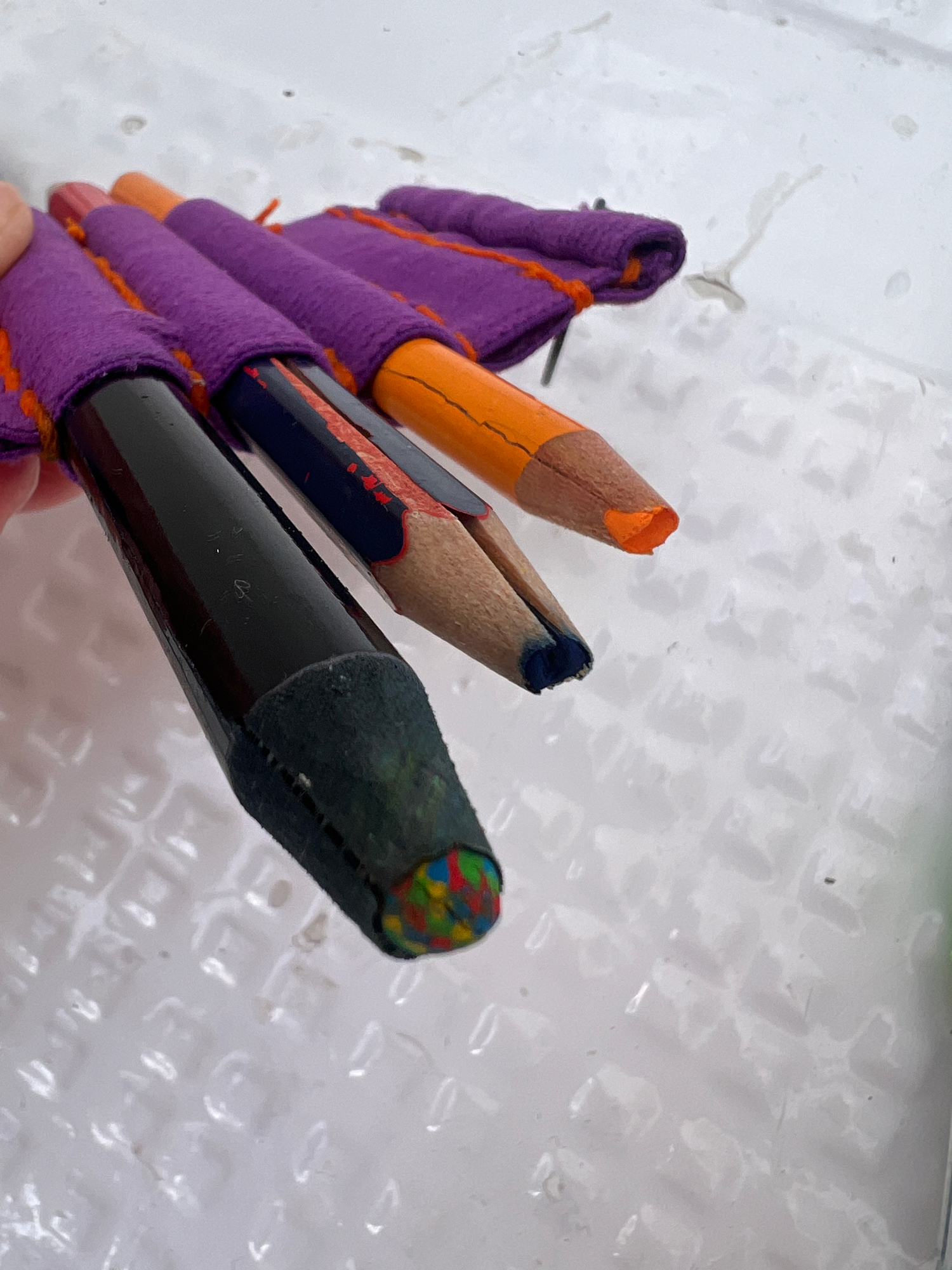
Here is how my tools looked after one of the dives where I got to sketch:

Note how my wood pencils cracked (I think that water pressure at 100 feet depth plus saltwater working on the glue which holds pencils together made this happen). The mechanical pencils that I tested performed excellently, and I will keep them in my tool set.

And paper notes you can see in these images:
What is in the pictures but might not be obvious is a plastic board for support and subber bands of all sorts - to hold paper in place and to hold my drawing tools. 


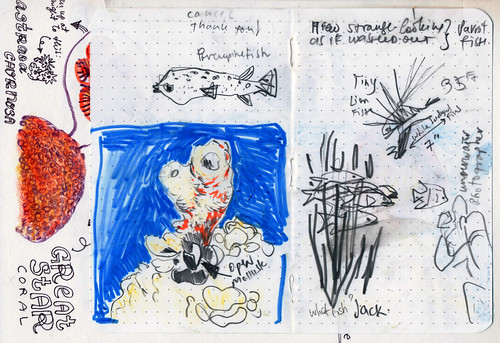
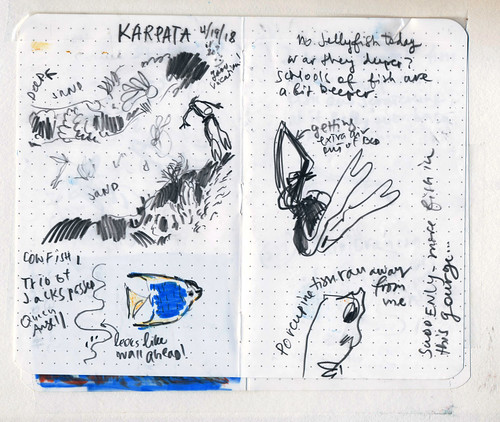
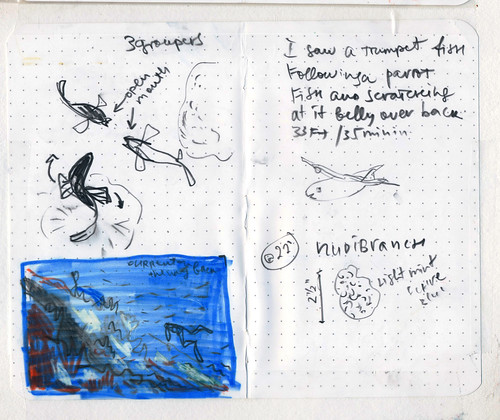
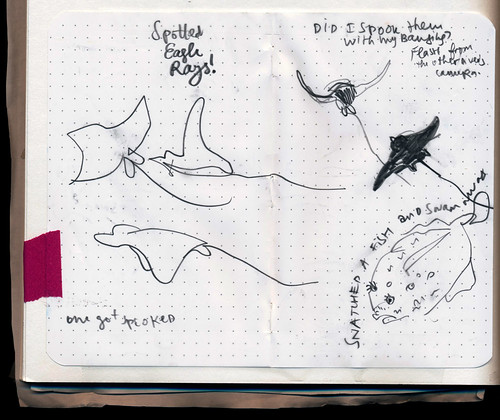
Nina Khashchina Sketchbook #113: Trip to Bonaire - Underwater Sketching / Scuba Diving with a Sketchbook

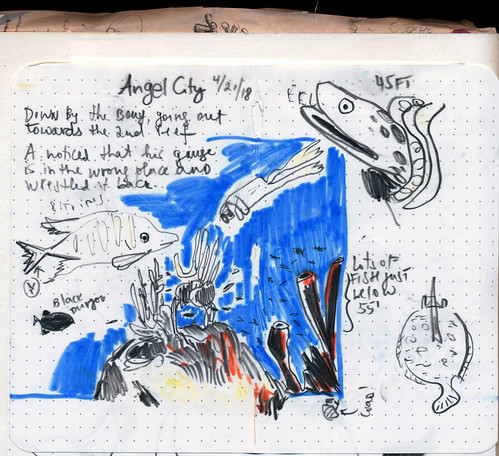
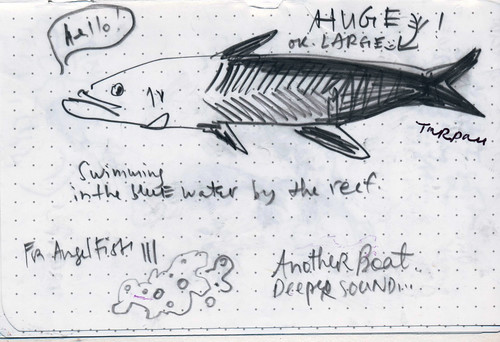
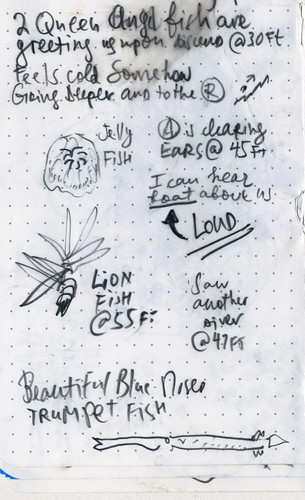
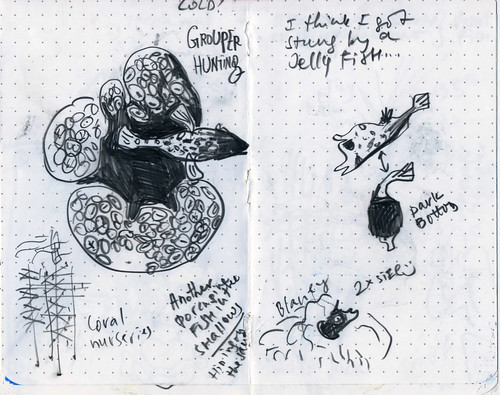
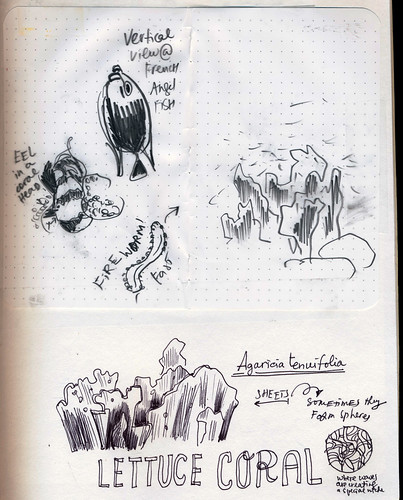
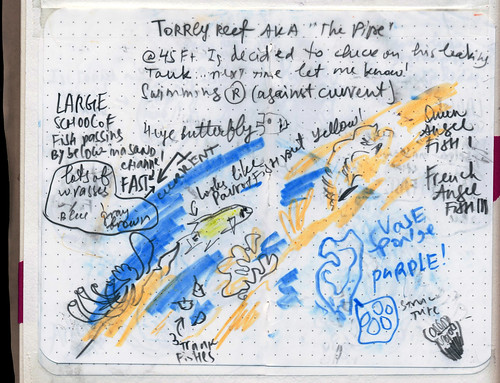
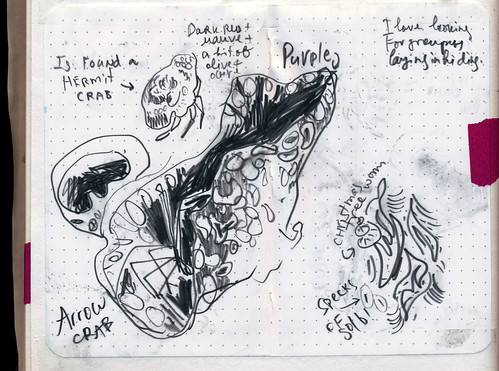
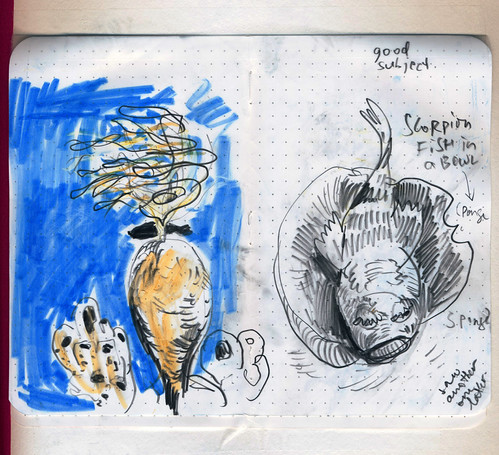
Last monster-post with the underwater sketches from my Bonaire trip: another turtle, all kinds of crabs, Scorpion fish, an unexpected peacock flounder, lion fish, trumpet fish, grouper hunting... eels and more!
Sketchbook #113: Trip to Bonaire - Underwater Sketching / Scuba Diving with a Sketchbook Sketchbook #113: Trip to Bonaire - Underwater Sketching / Scuba Diving with a Sketchbook Sketchbook #113: Trip to Bonaire - Underwater Sketching / Scuba Diving with a Sketchbook Sketchbook #113: Trip to Bonaire - Underwater Sketching / Scuba Diving with a Sketchbook Sketchbook #113: Trip to Bonaire - Underwater Sketching / Scuba Diving with a Sketchbookhchina Sketchbook #113: Trip to Bonaire - Underwater Sketching / Scuba Diving with a Sketchbook Sketchbook #113: Trip to Bonaire - Underwater Sketching / Scuba Diving with a Sketchbook Sketchbook #113: Trip to Bonaire - Underwater Sketching / Scuba Diving with a Sketchbook Sketchbook #113: Trip to Bonaire - Underwater Sketching / Scuba Diving with a Sketchbookhchina Sketchbook #113: Trip to Bonaire - Underwater Sketching / Scuba Diving with a Sketchbook Sketchbook #113: Trip to Bonaire - Underwater Sketching / Scuba Diving with a Sketchbook Sketchbook #113: Trip to Bonaire - Underwater Sketching / Scuba Diving with a Sketchbook Sketchbook #113: Trip to Bonaire - Underwater Sketching / Scuba Diving with a Sketchbook Sketchbook #113: Trip to Bonaire - Underwater Sketching / Scuba Diving with a Sketchbook Sketchbook #113: Trip to Bonaire - Underwater Sketching / Scuba Diving with a Sketchbook