Showing posts with label drawing underwater. Show all posts

Virtual Traveling (with Street View World Tour) - Underwater!

On the first Thursday of each month, a bunch of people meet online to do some virtual traveling and sketching. It is called Street View World Tour and is hosted by @herbcoil and @ronkiponk, and sponsored by @gageacademyI am a huge fan - and try to attend every month. And this month I was a presenting artist - for the second time! The first time I took everyone to draw the city where my family is from, Kharkiv in Ukraine. And this time I took everyone underwater! A fantastic group of people with whom I shared my enthusiasm for sketching while scuba diving visited Japan, Australia, and the Caribbean. 
Images below are from the demo I did: three takes with three different material sets to illustrate how my sketching might go underwater, and we did a warm-up sketch before and two longer sessions after - all the time chatting about different materials, challenges, and adventures that one might encounter while scuba diving and drawing!

Trip to Bonaire: Sketching and Scuba Diving - Oil Pastels and Salt Water Mix Nicely

I wrote about my experiment with bringing oil pastels of different brands with me to my underwater sketching adventures on Bonaire. And below are several sketches which will show you how I: 

  • layered different colors (a lot of snugging, hard to judge results)
  • used a side of the pastel crayon to cover a large part of the page quicker (enjoyed A LOT)
  • how different pressure to different parts of the crayon created interesting texture variation (enjoyed A LOT)
  • how I used a tip or sharp edge of the crayon to add details or even write in some instances (this is ok - but I found a better way - will collect those sketches into a separate post).

Bear in mind that all the colors look very different when you are looking at them under 60-70 feet of water, so most of my color choices had to be "blind". I tried to limit the number of colors that I took with me, and remember the overall shape of the crayon, and remember how the hue would shift (from the theory that red color disappears first and so on), and from previous experience.


All Posts re: Bonaire 2025:

What I Packed For A Trip (Underwater Sketching Kit)

I already shared what I used for my surface sketching on a recent trip, and this is a story of what I took with me to sketch underwater. 
Now, normally, I would start with a photo of my setup with some written comments. However, this time the sea took somewhat more of my tools than usual, so I cannot show you all of them - but I have older photos and some stories as to how this happened, and, hopefully, how to prevent this from happening in the future are at the end of this post. 


So here is what is in my basic kit for sketching underwater:
A. support board (8.5" x 6", thickness 1/16" , made out larger of Polyvinyl chloride (PVC) board, available at any construction or plastic store) 
B. water-resistant paper (this time I used GAK stone paper notebook cut to the size of my board)
C. binder clip to hold A to B
D. elastic band to make sure that pages are not "flying" (the movement of water when you are scuba diving is quite like a wind since you are in constant motion, not to mention that oftentimes you will have a current, which means a strong wind).
E. Pencil with a lanyard so that it can be attached either to my hand or to the board.

I have a variety of pencils - from a regular drawing pencil to which a nylon string was attached with superglue, to several chisel or flat pencils (to vary my line), to some pencils that were marketed as specifically created for scuba diving - you can see them all below. My favorite ones are listed in this post: https://blog.apple-pine.com/2025/01/underwater-sketching-kit.html.

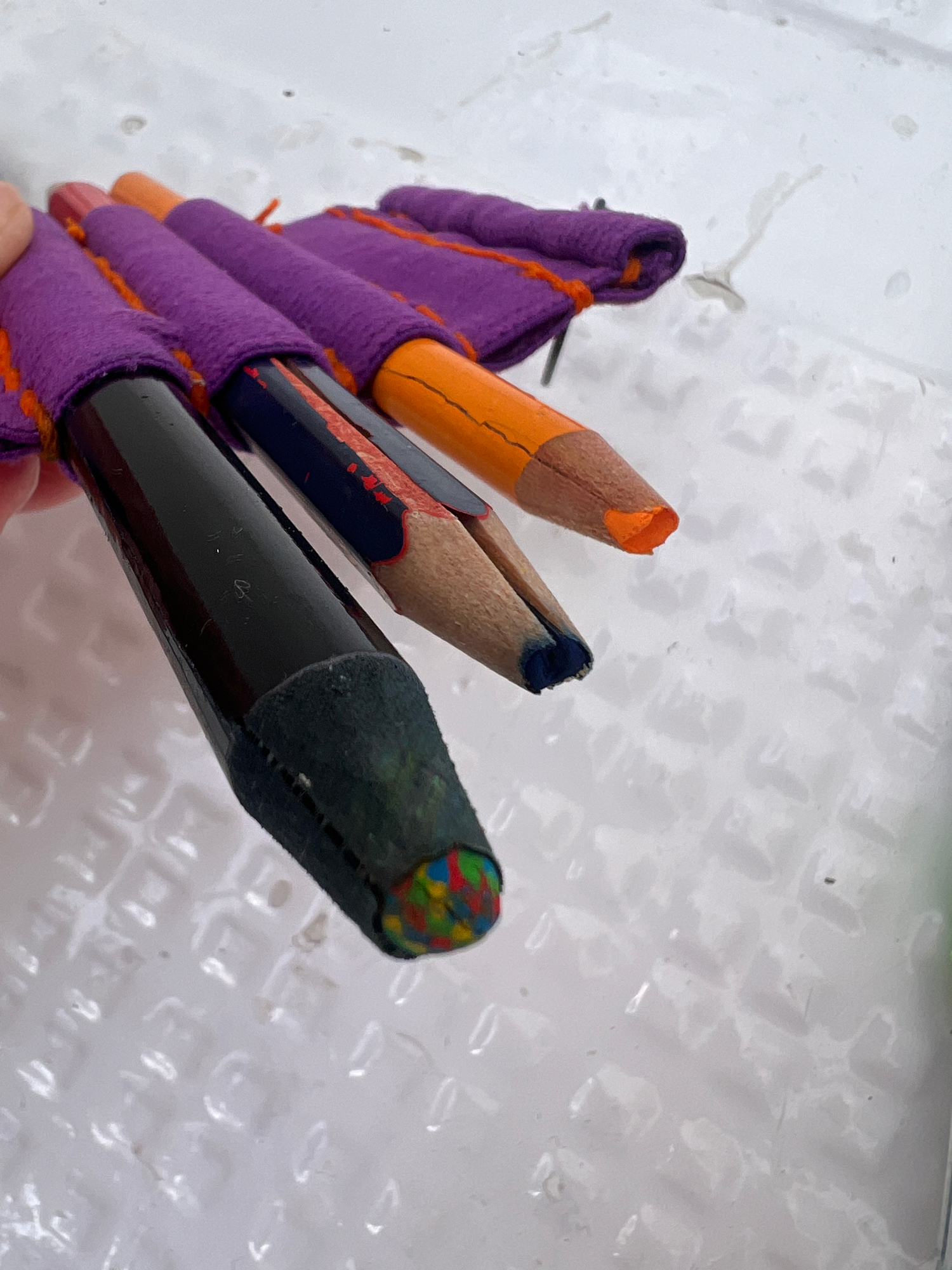
And I also take some colored pencils with me often. Having multiple colors in one tool is a big win, as everything that I take with me underwater needs to be attached to my body, and having too many things is not realistic to manage. So I use double-sided red and blue pencils or multi-color (aka rainbow) pencils and stick them in my wrist band (which I made out of a wide elastic band myself).

During this trip, I also took oil pastels with me. Since this was effectively a test run for this setup, I took pastels from as many manufacturers as I could find in my studio and used a little plastic bag with a lanyard to carry them. Every time I wanted to use one of these colors, I would open the bag, get one color out, and close the bag. Fortunately, pastels themselves are negatively buoyant, which means that they would not shoot to the surface the moment I opened my little bag.

Here is an image of my tools and how my set-up looked like:

Oil Pastel Manufacturers I used were:
Faber-Castell Grip Oil Pastels
Mungyo Gallery Artists' Soft Oil Pastels
Sennelier Oil Pastels
Caran d’Ache Neoart 6901 Wax Oil Pastels
(I took only one of each with me underwater to start). 

Naturally, the most expensive one (Sennelier) I lost right away, so I cannot say how well it would work.
Out of the remaining three brands, the Faber-Castell Grip Oil Pastels were the ones most affected by the pressure at the depth - they lost more of their ability for smooth application and did not give out color willingly, mostly creating uneven coverage, which felt like catching on the surface. 
Mungyo Gallery was amazingly malleable and retained its quality of drawing both when used at the edge to make a line and at the side to cover a large surface. But they also shed quite a bit of pigment onto other pastel sticks. And the highest level of control, clearness of line, and texture of application on a side were achieved with Caran d’Ache Neoart 6901 Wax Oil Pastels.

And here are some notes on what I lost and learned from this trip:
First, I lost my binder clip, which connected my board and paper pad. Then I found it, but then I lost it again. This is a moment to remember that two is one and one is none - I should have two clips.
Then I lost my support board. It was positively buoyant and shot to the surface when I spent too much time looking at a tiny cleaning shrimp that was sitting inside a beautiful sea anemone. I was trying to move as little as possible to get closer to the creature, and accidentally let go of my drawing setup and caught only the paper pad when it started floating away. I also lost a few pencils - some fell apart due to salt and pressure exposure (not much to do with this 0 just bring more spares), and one I took with me to a dusk dive and put it away in my pouch when it got dark, but it was not there when I surfaced. You will see that some of my materials have hairbands on a string, and I carried them on my wrist. However, hairbands become really tight at the depth, and while they work great to attach things to things like my webbing or clip, they are not suitable for my wrist - my hand-made pencil holder made out of a wide elastic band is still the best - but it is coming apart, and I should make a new one for the next trip. Carrying pastels in one would not be possible, as they get quite soft and would be hard to push in, and might lose a lot of their body. The current plastic baggie is a workable solution, but it takes some time to rummage through to get the right color out. 
 
Actual sketches (with some comments on the materials) are coming soon - I made over 50 pages of sketches underwater and sorting through them proved to be a bit of herculean task :)

Here is a link to my previous post on this subject - from a previous scuba diving trip:


Underwater Sketching Kit

Between my previous experiences of sketching while scuba-diving and some new ideas, I created a whole set of tools that I wanted to try on this trip. They included several papers to try, several pencils to try, and a new way to add color: oil pastel! While getting ready for this adventure I went to a refresher class for scuba diving (our last trip was before the pandemic) and that is where I tested my oil pastels set-up and was super excited to bring them with me! I knew that there would be at least 15 dives so I planned to try one tool at a dive first and then pick what worked the best and continue with that set-up till the end of vacation.
Here is what the plan for the tools looked like:
Three Papers: 
1. Right in the rain all weather notebook (Plain. This is what I've been using before in all my scuba diving sketching but I am not sure it is still available so the link goes to the closest thing I found).
2. Terra Slate Waterproof paper, 5 mm - I  got a pack of loose sheets and folded them in half for my support board. This paper was recommended to me by a Rory O'Keefe | SURVEY DOWN - an amazing underwater cave cartographer. 
3. Wire-Bound Stone Paper Notebook which I cut to match my support board (which is based on the size of my scuba diving pocket). 

Oil Pastels were a collection that I created from several sets - but Faber Castell box was plastic and convenient for both transporting and keeping them in place underwater.

Pencils:
Color pencils were two no-name multicolor ones (presents from friends actually!), double-pencil is Mitsubishi Vermilion and Prussian Blue and others are short prismacolor pencils. 
Graphite Pencils were chosen for all-plastic body which means they would not rust. And here is some info about them:
1. Pilot Croquis 6B (Pilot AP-CR4-6B Croquis 6B Sketch Pen - this is a closest link I found through it leads to a very pricy version - I got mine for $6 at some point) - a pleasure of soft graphite cannot be underestimated but at depth not too many pencils keep it - this one does! 
2. Morning Glory Sketch Mechanical Pencil provided a lovely option of making thin and thin lines by having a rectangular lead 1.8 mm flat,
3. Aqua Pencil from Reef Check - picked up at the local dive shop in a pre-pandemic life. 
4. Stabilo all Aquarellable Pencil - which writes on all sorts of surfaces 
5. Carpenter pencil allows for a wide variety of marks and I used wooded ones before - this was an experiment with an all-plastic housing - Swanson Tool Co CP216 AlwaysSharp Refillable Mechanical Carpenter Pencil. The pencil is too long for my comfort and I did not get to actually test it under water. 

However, things didn't go as planned. While preparing for scuba-diving in Maldives I looked up all sorts of information about aquatic life I might encounter, water temperature, and famous diving sites. But I did not register the fact that the Maldives are a place known for the abundance of currents, sometimes treacherous. We did not encounter anything worth mentioning ourselves but got a lot of warning during dive briefings. And there were many sites with current strong enough to take my mind off any drawing - we used hooks to stay in place or move in the direction where our guide would be going. And he would always be moving - which was also not conducive for drawing. Sticking with the guide was important as the boat was tracking groups of divers, and surfacing with the guide was key to ensuring we were picked up by our vessel. As a result, I did not go through all my sketching tools and did not get to try oil pastels. So they will have to wait for my next scuba-diving adventure :) 
Here what I actually used:
Here is how my tools looked after one of the dives where I got to sketch:

Note how my wood pencils cracked (I think that water pressure at 100 feet depth plus saltwater working on the glue which holds pencils together made this happen). The mechanical pencils that I tested performed excellently, and I will keep them in my tool set.

And paper notes you can see in these images:
What is in the pictures but might not be obvious is a plastic board for support and subber bands of all sorts - to hold paper in place and to hold my drawing tools. 


Sketchbook #113: Trip to Bonaire - Sketching above water and some notes on underwater tools.

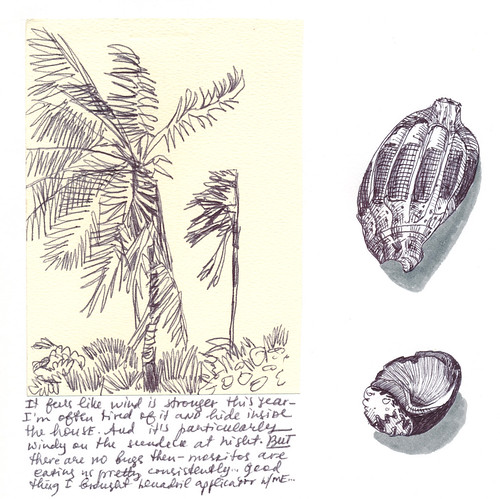
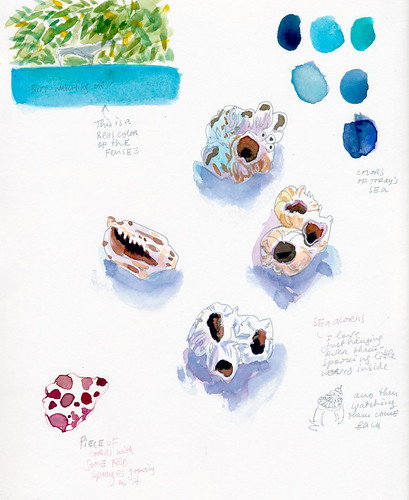
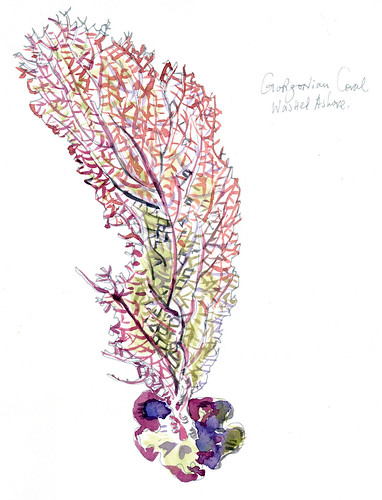
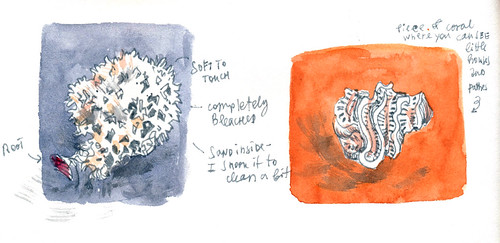
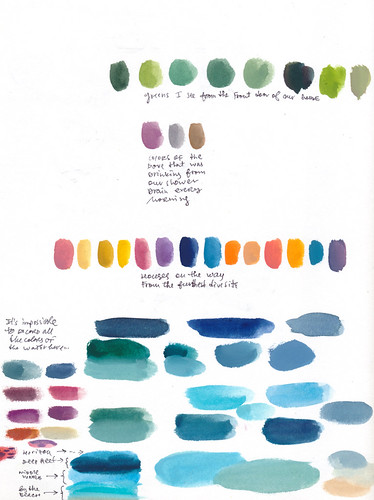
I drew some of my underwater subjects above water and just drew somethings around me too. The thing I always wanted to do and that did not work (again) is collecting all the colors I see on the island - it's an overwhelming task- and when you add it to the overwhelming of drawing everything I see underwater - one of them falls off the drawing board :)
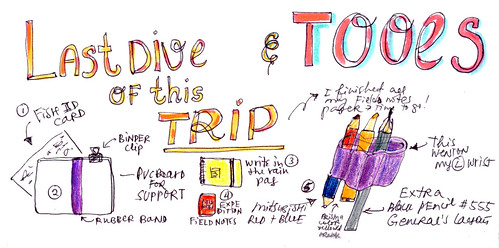
As for the tools: I used the rite-in-the-rain paper and amazingly sleek and indestructible expedition sketchbooks from Field Notes.
Little PVC board for the support was very useful as it allowed me to pack my fish ID cards, sketching tools and magnifying glass all in one place - which is critical for descend and ascend as well as any situations when you need all your attention not on sketching but on your scuba diving skills or buddies. Having everything attached to the support board allowed me to stove it away in my pocket quickly.
I used all sorts of pencils, tried regular wax crayons (not happy with the results) and still believe that plain mechanical pencil is the best. But I lost my favorite one during one of the dives :( After that, I sewed a little wristband which helped me to hold my pencils in one place and was large enough to see if/when it started to float away from me. (I saw my mechanical pencil floating on the surface from the depth of 70 feet but it was just the beginning of the dive and it did not make any sense to drag my buddies up to catch it.

Sketchbook #113: Trip to Bonaire -  Underwater Sketching Tools / Scuba Diving and Drawing Sketchbook #113: Trip to Bonaire - Sketching above water Sketchbook #113: Trip to Bonaire - Sketching above water7 Sketchbook #113: Trip to Bonaire - Sketching above water Sketchbook #113: Trip to Bonaire - Sketching above water9 Sketchbook #113: Trip to Bonaire - Sketching above water Sketchbook #113: Trip to Bonaire - Sketching above water Sketchbook #113: Trip to Bonaire - Sketching above water